
Swisher County Court Records After Arrest
After a Swisher County arrest, the record path splits. The jail track starts with booking at the Swisher County Jail, while the court track starts when a complaint, information, indictment, citation, or other charging instrument is filed. The jail's first listed charge is an allegation used for custody and booking. The prosecutor may later decline, amend, reduce, add, or present charges to a grand jury. Court records after a jail arrest are the filed judicial records that track that formal path.
Use jail inmate records for custody and booking questions. Use jail roster mugshots for booking-photo access questions. Court records after an arrest belong with the Swisher County & District Clerk once a case has been filed. The clerk's record tools do not prove that every same-day booking has a court case yet, so a short delay between arrest and case visibility is normal.
The clerk homepage is a core source for filed Swisher County court records. The image below is from the Swisher County & District Clerk website, which lists contact information, public computers, hours, and case-record access paths.
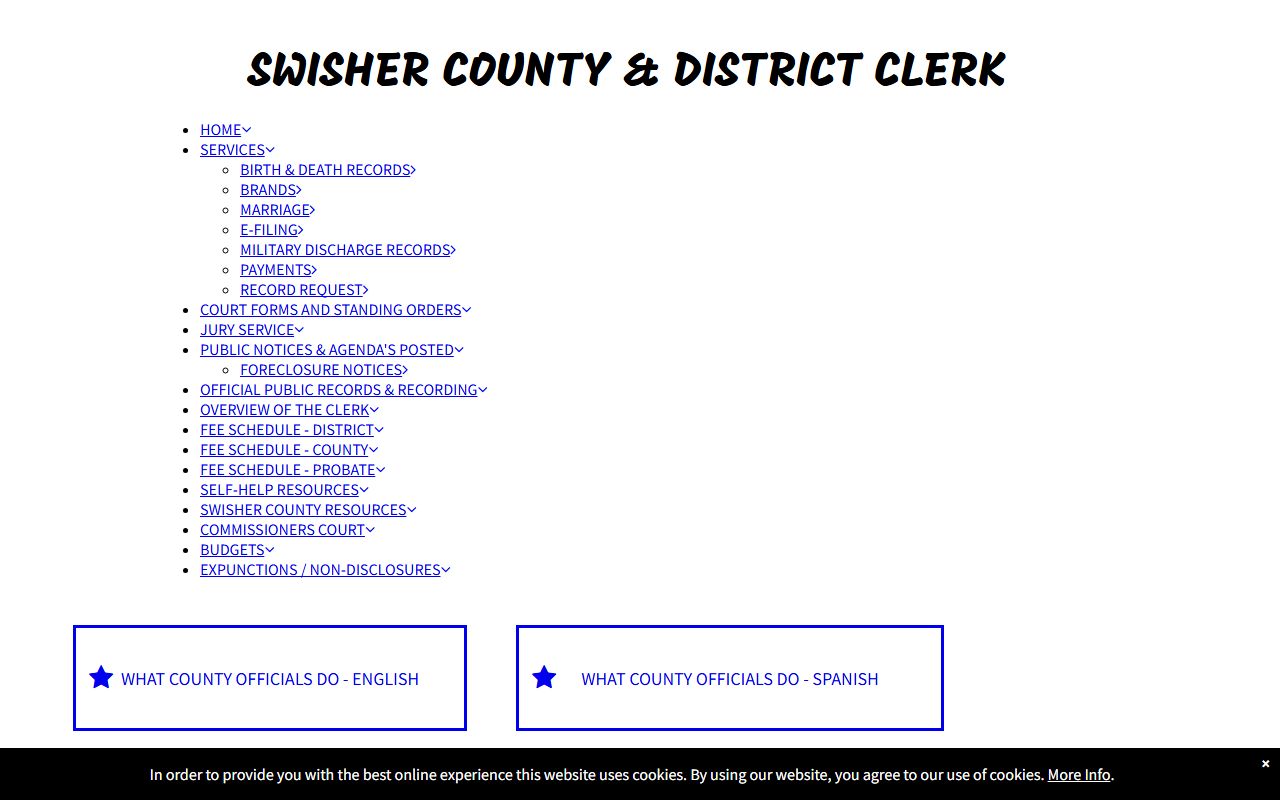
That clerk source is separate from the sheriff's booking record and should be used for court case filings, copies, and judicial record review.
Search Swisher County Court Records
The Swisher County & District Clerk is C J Chasco. The office is at 119 S Maxwell, Tulia, Texas, with phone numbers 806-995-3294 and 806-995-4396, and email cdclerk@swishercounty.gov. Hours listed by the clerk are Monday through Thursday from 8:00 a.m. to 5:00 p.m., Friday from 8:00 a.m. to 3:00 p.m., closed weekends, and open during lunch. In-office review has no charge, and the office has two public computers for searching judicial and property records.
The clerk says online indexes and case information for civil, criminal misdemeanor, felony, and probate records are available through iDocket from January 1, 1992 to current as data entry continues. The image below comes from the iDocket search service linked by the clerk.

Use iDocket as an index and case-information path, then contact the clerk when a copy, certification, or record availability answer is needed.
| Field or Path | Type | Required | Options or Format Notes |
|---|---|---|---|
| County or records portal | Portal selection | Yes | Swisher records are linked through iDocket by the clerk. |
| Case or index search | Portal search | Unspecified | Criminal misdemeanor, felony, civil, and probate indexes are described by the clerk. |
| Public computers | In-office search | No online field | Two public computers are available in the clerk's office. |
Find Court Records After Arrest
Start with custody only when the arrest is new. The court case may not exist until a charging document is filed. Once a case is filed, the clerk and iDocket are the better path for court records after a jail arrest in Swisher County. For statewide portal context, re:SearchTX may also be relevant, but access can depend on participating courts, account rules, and user type.
- Confirm custody or booking status through IVSS or the Swisher County Sheriff's Office if the arrest is very recent.
- Allow time for the prosecutor to file a charging document and for the case to appear in the clerk's index.
- Search iDocket for Swisher County criminal case information by the defendant name or case reference if known.
- Contact the clerk by email, fax, mail, or in person when the case is unclear or a copy is needed.
- Compare the filed charge to the original booking allegation before treating the charge as final.
Requests may be emailed to cdclerk@swishercounty.gov, faxed to 806-995-4121, or mailed to Swisher Clerk, 119 S Maxwell, Tulia, TX 79088. The clerk says requests will be reviewed and answered within 10 business days with availability and cost.
Swisher County Arrest Charging Records
Court records after a jail arrest are built from charging documents and later case filings. A complaint is a sworn accusation that can begin some proceedings. An information is a prosecutor-filed charging document used in many non-indictment criminal cases. An indictment is a grand-jury charging document, often tied to felony prosecution. The labels matter because a booking charge on a jail record may not match the charge filed in court.
| Charging Document | Who Uses It | What It Does |
|---|---|---|
| Complaint | Officer or prosecutor, depending on procedure | States an accusation or sworn basis for a criminal proceeding. |
| Information | Prosecutor | Files formal charges in many Texas non-indictment cases. |
| Indictment | Grand jury | Charges a felony or other eligible offense after grand-jury action. |
Swisher County's local County Attorney & Felony Jurisdiction page names Amy McAtee, gives the office address at 119 South Maxwell, phone 806-995-3505, and email swisherca@swisher-tx.org. District felony context also involves Wally Hatch, the 64th Judicial District Attorney in Plainview. The 64th District Court serves Castro, Hale, and Swisher Counties, and the 242nd District Court includes felony criminal cases.
Swisher County Charge Status Records
A charge status is not the same thing as a custody status. Custody status says whether a person is held, released, transferred, or otherwise under supervision. Charge status says where the filed court accusation stands. A court record can show a charge pending, amended, reduced, dismissed, disposed by plea, tried to verdict, or affected by later sealing or expunction rules.
| Status | What It Means | Record Caution |
|---|---|---|
| Pending | The filed charge is still open. | There is no final disposition yet. |
| Amended or reduced | The prosecutor or court changed the charge level or wording. | The booking charge may differ from the active charge. |
| Dismissed | The charge was ended without a conviction on that count. | Dismissal is not the same as automatic expunction. |
| Convicted or pled | The case ended in a conviction or plea outcome. | Check the judgment and sentence for exact terms. |
| Transferred or held | Another court or agency may control part of the case. | A local bond may not clear another-agency hold. |
Bond Records After Swisher Arrest
Texas Code of Criminal Procedure Chapter 17 governs bail and related release procedures. In Swisher County, a magistrate or court may set bond after arrest. The sheriff or jail may be able to say whether a bond amount or hold is visible, but the court order controls the legal release status. Ticket and citation payments are different from jail bond, and the clerk payment page warns that JP ticket payments should not be made through the clerk.
| Bond or Release Type | How It Works | Swisher Record Path |
|---|---|---|
| Cash bond | Full cash amount is posted as required by the court or jail procedure. | Confirm with the jail and court before payment. |
| Surety bond | A licensed surety or bondsman posts the bond. | Check jail custody and the case file for bond terms. |
| Personal or PR bond | Release is based on a promise to appear and court conditions. | Look for the bond order in court records. |
| No-bond hold | Ordinary bond posting will not cause release. | Ask whether another agency, parole, immigration, or court hold exists. |
Note: A release record can lag behind a court order if jail processing, transport, or another hold is still active.
Swisher County Court Records Fees
The clerk's record-request page gives the copy and certification costs for judicial records. Payment must be received before copies are produced. In-office review is available during normal business hours at no charge, which can be useful before ordering copies from a criminal case that followed a jail arrest.
| Item | Amount |
|---|---|
| Paper copies | $1 per page |
| Certified copies | $1 per page plus $5 certification |
| Electronic copies of digital records | $1 per page up to 10 pages, then 10 cents per page over 10 |
| Authentication or three-way certificate | $10 |
Warrants and Court Arrest Records
No official Swisher County sheriff active-warrant search or countywide warrant list was located. A separate City of Tulia warrant list exists, but the research identifies it as municipal-court specific, not a countywide sheriff warrant list. Texas Code of Criminal Procedure Chapter 15 defines arrest warrants, warrant contents, statewide effect, and the magistrate-warning process after arrest.
For warrant questions, contact the agency or court believed to have issued the warrant. The Swisher County Sheriff's Office is the local law-enforcement contact, the clerk can help with filed court case records, and the Justice of the Peace handles certain tickets and citation matters. Texas DPS public criminal history under Government Code Chapter 411 is a separate statewide criminal-history search, not the same thing as the Swisher clerk's local docket.
Charges Versus Convictions
A jail arrest and a filed charge do not mean a conviction. Court records after an arrest should be read by stage. The charge is the accusation or formal count. The conviction is a final outcome by plea, verdict, or judgment. A dismissed charge may still appear in older court or criminal-history materials unless a court order, sealing rule, or expunction process changes public access.
| Record Point | Charge | Conviction |
|---|---|---|
| Stage | Accusation filed in court. | Final court outcome after plea or verdict. |
| Proof | Based on charging process and probable cause standards. | Requires legal adjudication or plea. |
| Public meaning | Does not prove guilt. | Shows a completed criminal outcome. |
Sealed and Expunged Arrest Records
Texas Code of Criminal Procedure Chapter 55 governs expunction of qualifying criminal records. Expunction can require agencies to destroy or return records covered by an order. Sealing, nondisclosure, and expunction are not the same. A person seeking to clear or limit access to a Swisher County arrest-related court record should rely on the court order and legal advice, not a general search result.
| Access Limit | Sealed or Nondisclosed | Expunged |
|---|---|---|
| Public visibility | Restricted from ordinary public access. | Record may be destroyed, returned, or treated under the order's terms. |
| Agency access | Some official access may remain under Texas law. | Access is controlled by the expunction order. |
| Best proof | Signed court order and clerk record. | Signed expunction order and compliance by named agencies. |